Hurricane Tomas Strikes Haiti
Take some time to pray for the people of Haiti, who have suffered so much and who now must face a devastating new challenge.
Friday, November 5, 2010

Monday, November 1, 2010
New Saints in Roman Missal 3

The USCCB has an article on their website regarding propers for saints added to the Third Edition of the Roman Missal. Check it out at the link below.
USCCB - Roman Missal New Kids on the Block
USCCB - Roman Missal New Kids on the Block
Monday, October 11, 2010
A New Enthusiasm
What is needed at the present time is a new enthusiasm, a new joy and serenity of mind in the unreserved acceptance by all of the entire Christian faith, without forfeiting that accuracy and precision in its presentation which characterized the proceedings of the Council of Trent and the First Vatican Council. What is needed, and what everyone imbued with a truly Christian, Catholic and apostolic spirit craves today, is that this doctrine shall be more widely known, more deeply understood, and more penetrating in its effects on men's moral lives. What is needed is that this certain and immutable doctrine, to which the faithful owe obedience, be studied afresh and reformulated in contemporary terms. For this deposit of faith, or truths which are contained in our time-honored teaching is one thing; the manner in which these truths are set forth (with their meaning preserved intact) is something else.
These words sound as if they could have bee written today. Instead, they were proclaimed forty-eight years ago today, as Pope John XXIII convened the Second Vatican Council.
For people of my generation and older, Vatican II is part of our living history. For people in their 30's and younger, it is a thing of the past, something they read and hear about but have not really experienced. Still, Vatican II seems to be part of the collective Catholic lexicon, often cited with little real knowledge of why the Council was called, what the Council said, and what all of this means to the life of the Church and to each human person.
We argue about what the Second Vatican Council said about the Church Universal, the liturgy, the laity, the clergy, and many other important matters. But have we achieved the "new enthusiasm," called for by Pope John? Do we crave "that this doctrine shall be more widely known, more deeply understood, and more penetrating in its effects on men's moral lives?"
Today may be a good day to read Pope John's opening address to the Council. Towards its conclusion he reminded the gathered prelates of the importance of the Council saying,
The eyes of the world are upon you; and all its hopes.
Let us give thanks to God for his servant, Pope John XXIII and for all of those who so faithfully sought the counsel of the Holy Spirit during that important time in history. May we show our thanks by honoring their work and seeking the Spirit with the same fervor, charity and patience.
Friday, September 10, 2010
Workshop for Extraordinary Ministers of Holy Communion Added
 The Office of Worship has added an additional workshop for Extraordinary Ministers of Holy Communion at St. Mary Parish in Pardeeville this fall. The remaining workshops are listed below.
Sacred Hearts Parish in Sun Prairie
Wednesday, September 22 at 7 p.m.
Nativity of Mary Parish in Janesville
Saturday, September 25 at 9 a.m.St. Peter in Madison
Wednesday, September 29 at 7:30 p.m.
for Madison east side parishes
St. Mary Parish in Pardeeville
Saturday, October 23 at 9 a.m.
For more information or to register, go to www.madisondiocese.org/emhc.
Over 5800 people have attended these workshops since September 2007.
(Artwork: La multiplication des pains by Corrine Vonaesch)
Thursday, September 9, 2010
Pastoral Companion to the Roman Missal

World Library Publications is preparing to publish a Pastoral Companion to the Roman Missal by popular scholar/author Fr. Paul Turner. While I have not yet seen it, the description looks like this will be a very useful tool as we begin to pray with the newly translated texts. Here is the information from the publisher:
This is the essential companion to the new English translation of the Roman Missal. Father Paul Turner walks you through the newly translated Entrance and Communion Songs, Collects, Prayers over the Gifts, and Postcommunion Prayers for Sundays and Solemnities. Helpful pastoral suggestions and historical background are provided in a clear, concise, accessible manner. This eminently pastoral book is packed with helpful scholarship, making connections between the texts of the Missal and the Lectionary. Special bonus: introductions and conclusions to the Prayer of the Faithful for each Sunday and Solemnity, written in new Missal "style." A must-have!Click here for more information.
I'll be placing other resources on the blog as time moves forward. If you have any suggestions, let me know.
Wednesday, September 8, 2010
A Cause for "Great Concern"
The Vatican released a communique from the Pontifical Council for Inter-Religious Dialogue concerning current events in our country and around the world.
VATICAN CITY, 8 SEP 2010 (VIS) - The Pontifical Council for Inter-religious Dialogue today released an English-language communique describing its "great concern at the news of the proposed 'Koran Burning Day' on the occasion of the anniversary of the 11 September tragic terrorist attacks in 2001 which resulted in the loss of many innocent lives and considerable material damage.
"These deplorable acts of violence, in fact, cannot be counteracted by an outrageous and grave gesture against a book considered sacred by a religious community. Each religion, with its respective sacred books, places of worship and symbols, has the right to respect and protection. We are speaking about the respect to be accorded the dignity of the person who is an adherent of that religion and his/her free choice in religious matters.
"The reflection which necessarily should be fostered on the occasion of the remembrance of 11 September would be, first of all, to offer our deep sentiments of solidarity with those who were struck by these horrendous terrorist attacks. To this feeling of solidarity we join our prayers for them and their loved ones who lost their lives.
"Each religious leader and believer is also called to renew the firm condemnation of all forms of violence, in particular those committed in the name of religion. Pope John Paul II affirmed: 'Recourse to violence in the name of religious belief is a perversion of the very teachings of the major religions' (address to the new ambassador of Pakistan, 16 December 1999). His Holiness Pope Benedict XVI similarly expressed, 'violence as a response to offences can never be justified, for this type of response is incompatible with the sacred principles of religion' (address of His Holiness Benedict XVI, to the new ambassador of Morocco, 6 February 2006)".
Friday, September 3, 2010
Lord, Give Success to the Work of Our Hands
 As we approach Labor Day, I think that it is good to reflect upon and to re-orient ourselves toward the role of work in God's mysterious plan.
Our faith calls us to value work, to desire to work, and to put in an honest day's work. At the same time our faith requires employers to provide a just wage and to allow full access to employment without unjust discrimination (see Catechism of the Catholic Church, nos. 2426-2436).Human work proceeds directly from persons created in the image of God and called to prolong the work of creation by subduing the earth, both with and for one another. Hence work is a duty: "If any one will not work, let him not eat (2 Thess 3:10, cf. 1 Thess 4:11)." Work honors the Creator's gifts and the talents received from him. It can also be redemptive. By enduring the hardship of work in union with Jesus, the carpenter of Nazareth and the one crucified on Calvary, man collaborates in a certain fashion with the Son of God in his redemptive work. He shows himself to be a disciple of Christ by carrying the cross, daily, in the work he is called to accomplish. Work can be a means of sanctification and a way of animating earthly realities with the Spirit of Christ. Catechism of the Catholic Church, no. 2427
There is so much talk about work these days, especially since so many people are unemployed and many, many more are underemployed. To make enough money to pay the bills or to have health insurance, many work long hours which impact the quality of their family lives. "Work is for man, not man for work," the Catechism reminds us (2428).
I think that Labor Day provides a chance for all of us to first thank God for the gift of work along with the many other gifts that he freely and generously gives us (life, faith, family, Church, creation, food, etc). It is also a time to pray for those who are in need of work.
Finally, I think it provides an opportunity to examine our own consciences about our view of human labor within the context of our faith:
- If I have a job, do I put in an honest day's work? Am I honest and truthful? Am I respectful of other's property or do I feel entitled to take things from work that aren't mine? Do I treat coworkers with respect? Am I charitable? Do I put work ahead of family? Do I rest from work on Sundays?
- If I do not have a job, have I done all that I can to search for a job? Have I tried to improve my skills or study a new field? Have I given up hope? Do I seek God's guidance and sustenance? Am I angry with God? Do I use the time that I now have doing something positive? Do I still seek to help others as best as I can?
- Whether or not we have a job, all of us can ask ourselves, Do I respect all people regardless of whether or not they have a job? Do I respect all people or do I judge people based on status or job? Do I have compassion for people who work in difficult conditions? Do I value companies that provide fair and just labor standards when I consider a purchase? Do I begrudge someone who gets government or other assistance when unemployed or underemployed? Have I reflected upon the Catholic position regarding immigration?
A number of years ago I was asked by our Office for Justice and Peace to compose a litany to be used on Labor Day. I try to review it each year around Labor Day to remind myself of the dignity God has bestowed upon work and worker alike. I wrote about it last year and it can be found by clicking here.
Below is a prayer (slightly adapted, for personal prayer) from the Sacramentary (Masses for Various Needs and Occasions: For the Blessing of Human Labor):
God our Father,
by the labor of men and women you govern and guide to perfection
the work of creation.
Hear the prayers of your people
and give all men and women work
that enhances their human dignity
and draws them closer to each other
in the service of their brothers and sisters.
We ask this through Christ our Lord.
Amen.
Friday, August 27, 2010
Here Come the Irish
The University of Notre Dame's Center for Liturgy has an impressive site dedicated to web catechesis on the Roman Missal.
The site includes video presentations from Msgr. Bruce Harbert (the former Executive Director of ICEL who was in charge of the new translation), Fr. Michael Joncas, Fr. Douglas Martis, Msgr. James Moroney (a consultant to the Congregation for Divine Worship and Discipline of the Sacraments), Fr. Anthony Ruff, OSB, Fr. Paul Turner and Sr. Joyce Ann Zimmerman, C.PP.S. The videos vary in length and include solid catechesis.
Topics vary from the theoretical to the practical and address all aspects of the Roman Missal, including the theology, explanation of translation changes and issues surrounding music. This definitely is a site to bookmark.
Thursday, August 26, 2010
Roman Missal Workshop Added in Montello
We have added one more location to our diocesan introductory workshops on the Roman Missal. It will be on Wednesday, October 6 at St. John the Baptist Parish in Montello. Go to the Office of Worship's Roman Missal page for more information.
One workshop already has been held in Madison and another will be offered today in Sun Prairie. Future workshops will be held in Lancaster (September 1), Madison (September 1), Beloit (September 8), Spring Green (September 23), and now in Montello (October 6).
One workshop already has been held in Madison and another will be offered today in Sun Prairie. Future workshops will be held in Lancaster (September 1), Madison (September 1), Beloit (September 8), Spring Green (September 23), and now in Montello (October 6).
Tuesday, August 24, 2010
More Questions Than Answers
NOTE: After posting the text below on the Roman Missal I noticed that the "art of the day" was a 16th-century depiction of the Tower of Babel. Someone has a sense of humor! I thought that I would include it with the post.
 The U. S. Bishops' Committee on Divine Worship has really gotten out ahead of the third edition of the Roman Missal and their website has a lot of good information. Today they issued an updated version of FAQs.
In our own diocese we began our series of introductory workshops today. This morning about 70 pastors, liturgists, musicians, catechists and other parish leaders met at the O'Connor Center to discuss the Roman Missal. We had a lively meeting with some good suggestions and many questions raised. We have a lot of corporate wisdom among the priests, deacons and lay leaders of the diocese. The longer I am here the more I have grown to respect that!
Perhaps the most insightful question was this: What do I say to the parishioner who asks me how this will make him/her a better Catholic?
That's really the heart of the matter. How do we become better Catholics, more Christlike, through our participation in the Sunday Eucharist?
It reminded me a bit of one of my own family stories. Several years ago, when my oldest child was three, we attended Easter Sunday Mass at our (pro)cathedral. The bishop likes to chant the Pater Noster in Latin on many major feasts and we did so that day.
Later that afternoon, while coming off a sugar buzz, my daughter said, "Daddy! We didn't pray the Our Father this morning at church."
"We did," I said and explained that we chanted it in Latin. "Why?" she asked.
I was caught off guard a bit (I am embarrassed to say). I couldn't really say, "Well, dear, article 36.1 of the Constitution on the Sacred Liturgy says that Latin is to be preserved in the liturgy." Or even, "Pope Benedict encouraged the use of Latin in the liturgy in his apostolic exhortation, Sacramentum Caritatis (no. 62)."
So I sought, and found, the perfect answer: "Ask your mother."
Anyway, while our congregations are made of adults (who deserve to be treated as adults), it won't fly with too many Americans to say that our translation is changing because of Liturgiam Authenticam, or because we wish to capture the unique structure of the beauty of the Latin or any other such answer. The translation will change...will our hearts? How will this new translation help all of us worship God with a fuller heart, mind and voice?
I have my ideas on the matter and will share as time goes on. Any ideas from you? Post a comment.
Monday, August 23, 2010
An Educational Journey: The Roman Missal and Love
Sr. Mary Ann Walsh, Director of Media Relations for the USCCB, wrote an interesting blog entry regarding the Roman Missal. "We Catholics are about to embark on an educational journey," she writes. The brief entry includes some thoughtful reflections on the use of less common-place words in the new translation. Click here to view her article.
The entry has also sparked a heated exchange on the USCCB Facebook page, with all of the usual accusations being thrown about. There are a lot of angry people out there who either love the new translation or love the old one. Unfortunately, they appear not to love each other.
I keep coming across the phrase that real charity doesn't mean being "nice" but sharing the truth. I heartily disagree! Saint Paul said (I Corinthians 13) that love is, among other things, kind, humble and not rude. The Truth is Love. God is Love. Name-calling and attributing motives to others with whom we differ is neither Truth nor Love. The First Letter of Saint John says: "Whoever is without love does not know God, for God is love" (I John 4:8). Therefore it is important for us always to examine our hearts (and our words and actions) for the presence or absence of love.
Teaching others requires a great deal of love and discipline. Without this, I believe that we are on a slippery slope whereby we become a counter-witness, turning others away. We can plant the seed and live it ourselves, with God's grace. We can nurture it in others through prayer and example, through love and encouragement. As St. Francis of Assisi is said to have instructed others, "Preach the Gospel without ceasing. Use words when necessary."
Love does not require silence, acquiescence, timidity or capitulation. In fact, the opposite is true. Love is bold, zealous and all-conquering. Love makes one vulnerable and yet tenacious. It appears weak but is strong.
Beloved, let us love one another, because love is of God; everyone who loves is begotten by God and knows God. Whoever is without love does not know God, for God is love. In this way the love of God was revealed to us: God sent his only Son into the world so that we might have life through him. In this is love: not that we have loved God, but that he loved us and sent his Son as expiation for our sins. Beloved, if God so loved us, we also must love one another. No one has ever seen God. Yet, if we love one another, God remains in us, and his love is brought to perfection in us. (I John 4:7-12)
Friday, August 20, 2010
Roman Missal is Now Approved
Cardinal Francis George, OMI, president of the United States Conference of Catholic Bishops [USCCB], announced today the United States Bishops have received the final text of the Roman Missal. While the Order of Mass was approved in 2008, this marks the completion of the entire Roman Missal for the dioceses of the United States.
The approved text, previously available online, has some slight changes, according to a letter from the Bishops' Committee on Divine Worship Secretariat. These changes are:
The Missal will be available for use in Advent 2011. The study text will be posted on the USCCB website soon at www.usccb.org/romanmissal.
A more complete article from Catholic News Service is available here.
Our own diocesan workshops for priests and parish leaders will begin next week and discuss the Roman Missal in detail. Go to www.madisondiocese.org/romanmissal for more information.
The approved text, previously available online, has some slight changes, according to a letter from the Bishops' Committee on Divine Worship Secretariat. These changes are:
- the words of absolution in the Penitential Act have been modified (so that the text of the current Sacramentary is maintained);
- the addition of "I believe" at three points in the Profession of faith;
- several slight modifications to the texts of the Eucharistic Prayers;
- the final doxology of the Eucharistic Prayer has been slightly altered.
The Missal will be available for use in Advent 2011. The study text will be posted on the USCCB website soon at www.usccb.org/romanmissal.
A more complete article from Catholic News Service is available here.
Our own diocesan workshops for priests and parish leaders will begin next week and discuss the Roman Missal in detail. Go to www.madisondiocese.org/romanmissal for more information.
Tuesday, August 10, 2010
Altar Servers
Catholic News Service reported yesterday that the Vatican's newspaper, L'Osservatore Romano, included a story which praised the Vatican's 1994 decision, during the pontifcate of Pope John Paul II, to allow girls to serve as altar servers. The article appeared shortly after Pope Benedict XVI met with 25,000 altar servers in St. Peter's Square, of which 60% were girls and young women.
The report from CNS said,
The CNS article concludes mentioning the 2001 clarification which stated that priests could not be required by their bishop to use girls and women as altar servers.
The full text of the article is available here.
The report from CNS said,
Assisting the priest during Mass is both a service and a privilege and represents "a deep and responsible way to live one's Christian identity," said an article published Aug. 7 in L'Osservatore Romano.
"The exclusion of girls from all of this, for the sole reason of their being female, has always weighed heavily and represented a deep inequality within Catholic education," it said.
The CNS article concludes mentioning the 2001 clarification which stated that priests could not be required by their bishop to use girls and women as altar servers.
The full text of the article is available here.
Thursday, July 1, 2010
Friday, April 30, 2010
Concert Season

There are several choral concerts in our diocese during these next few weeks. Here are a few (click on the links for more information):
Saturday, May 8 at 7:30 p.m.
Bishop O’Connor Catholic Pastoral Center
Madison Diocesan Choir Spring Concert
Monday, May 10 at 7:30 p.m.
St. Andrew in Verona
The University of Notre Dame Liturgical Choir (pictured above)
Sunday, May 23 at 2 p.m.
Our Lady of the Assumption Parish in Beloit
The OLA Parish Choir Concert
All of these concerts are free.
Incoming Missal
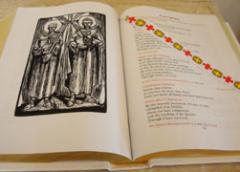
The United States Conference of Catholic Bishops issued a press release today announcing that the revised Roman Missal has received the required recognitio from the Holy See.
A timeline for implementation has not yet been announced.
Wednesday, April 28, 2010
Publication of Roman Missal is "Imminent"
The National Catholic Register published an article today saying that the Congregation for Divine Worship and Discipline of the Sacraments would issue the recognitio (approval) of the English-language Roman Missal today. While no official word has been given, Vatican radio reported on the meeting of Pope Benedict XVI and the Vox Clara working group of bishops preparing the final version of the Missal. Vatican Radio referred to the publication as "imminent."
As of noon CT, there is no official report acknowledging the recognitio.
As of noon CT, there is no official report acknowledging the recognitio.
Friday, April 9, 2010
In the Name of Jesus
 The first reading for today's Mass is taken from the Acts of the Apostles (4:1-12) and is one which visitors to the O'Connor Center may find familiar. The artistic highlight of the chapel is floor-to-ceiling mosaic depicting the scene from this Scripture.
The 30-foot mosaic is original to the chapel, which was dedicated in 1964. It was designed by a German-born artisan in Milwaukee, Felix G. Senger, and assembled in Berlin. Many people involved in the project remember its installation because it first was laid out in the lobby of the seminary and then assembled--piece by piece--on the chapel wall. The mosaic is composed of glass and marble and is made up of over 360,000 pieces.
The Risen Christ stands radiantly as the focal point of the artwork, showing the glorified wounds on his hands in the familiar orans position.
On the lower third of the mosaic is depicted the climax of the account of Peter and John healing a disabled man outside of the temple (previous portions of this were read on Wednesday and Thursday of this week).
Peter and John were going to the temple for prayer, and this man, disabled from birth, was begging for alms at the "Beautiful Gate" of the temple. Upon hearing him, Peter looked him in the eye and said, "I have neither silver nor gold, but what I do have I give you: in the name of Jesus Christ the Nazorean, (rise and) walk" (Acts 3:6). The man did just that, amazing all who were familiar with him.
Peter and John began preaching to all who had witnessed the miracle, but they were arrested on orders from the temple leaders. Jailed over night, they were questioned the following day. When asked on what authority they had healed this man, Peter was filled with the Holy Spirit and his testimony is inscribed in the mosaic:
In the name of Jesus Christ of Nazareth
whom you crucified,
whom God has raised from the dead,
even in this name
does he stand before you sound. (Acts 4:10)
This inscription highlighted the original name of the building, "Holy Name Seminary." The building was built by the first Bishop of Madison, Bishop William P. O'Connor (1886-1973). His episcopal motto, In Nomine Jesu (In the Name of Jesus), gave rise to both the building's name and the mosaic's image. Bishop O'Connor was a "Council Father," having attended the first two sessions of the Second Vatican Council.
The Seminary was formally closed in 1995 and was renovated in 1998. The building was renamed to honor that first bishop and is now the Bishop O'Connor Catholic Pastoral Center. The Chapel was renamed the Bishop O'Donnell Holy Name Memorial Chapel. The chapel was beautifully renovated at that time and magnificent stained glass windows were installed depicting Christ, the saints (including one of the first depictions of Blessed Teresa of Calcutta--Mother Teresa--in the world), and the works of mercy that we are called to perform as the Body of Christ.
On a side note, I have always felt that mosaics shed some light on the nature of the Church. Hundreds of thousands of pieces of glass and marble are used in this particularly mosaic, and each one is important. Some are made in brilliant colors--gold, maroon and red. Some are less brilliant and in muted tones. Some make up important figures--the face of Christ or the hand of Peter--while others are relegated to seemingly less important areas--an apostolic toe or perhaps a simple piece of the background far from where the eye is drawn.
Yet each uniquely shaped and colored piece is important and adds to the beauty of the whole. Each has a place and a job. If even one piece of glass was removed from the least significant portion of this mosaic, we would notice. The beauty of the whole would be diminished. If one piece was too brilliant it, too, would diminish the whole, detracting from the overall beauty and calling attention to itself.
Like a mosaic, we can't all be the most beautiful, eloquent, or influential in the Church. But each one is needed or the entire Body is diminished.
Wednesday, April 7, 2010
Enjoy this Festival!
My favorite Easter homily comes from the great Eastern saint, John Chrysostom (347-407). As priest and later Archbishop of Constantinople he was known for the eloquence of his preaching, earning the title Chrysostom (golden-mouthed).
The homily (below) is followed by a clip from J. S. Bach's (1685-1750) great Easter Cantata, Christ lag in Todesbanden (Christ lay in the bonds of death). This cantata's text and melody are based upon the Easter Sequence Victimae Paschali laudes (Praise the Paschal Victim). The homily and music...written 1300 years apart by the greatest Orthodox preacher and the most gifted Lutheran musician, seem to make a nice combination.
Happy Easter!
Below is the fifth movement of Christ lag in Todesbanden as sung by the gifted ensemble Cantus Cölln.
And, because it is such a wonderful piece of music, here is the first half of the cantata.
The homily (below) is followed by a clip from J. S. Bach's (1685-1750) great Easter Cantata, Christ lag in Todesbanden (Christ lay in the bonds of death). This cantata's text and melody are based upon the Easter Sequence Victimae Paschali laudes (Praise the Paschal Victim). The homily and music...written 1300 years apart by the greatest Orthodox preacher and the most gifted Lutheran musician, seem to make a nice combination.
Happy Easter!
An Easter Homily by Saint John Chrysostom
Are there any who are devout lovers of God? Let them enjoy this beautiful bright festival!
Are there any who are grateful servants? Let them rejoice and enter into the joy of their Lord!Are there any weary from fasting? Let them now receive their due!
If any have toiled from the first hour, let them receive their reward.
If any have come after the third hour, let them with gratitude join in the feast!
Those who arrived after the sixth hour,let them not doubt; for they shall not be short-changed.
Those who have tarried until the ninth hour, let them not hesitate; but let them come too.
And those who arrived only at the eleventh hour, let them not be afraid by reason of their delay.
For the Lord is gracious and receives the last even as the first. The Lord gives rest to those who come at the eleventh hour, even as to those who toiled from the beginning. To one and all the Lord gives generously. The Lord accepts the offering of every work. The Lord honors every deed and commends their intention.
Let us all enter into the joy of the Lord!
First and last alike, receive your reward.
Rich and poor, rejoice together!
Conscientious and lazy, celebrate the day!
You who have kept the fast, and you who have not, rejoice, this day, for the table is bountifully spread!
Feast royally, for the calf is fatted.
Let no one go away hungry.
Partake, all, of the banquet of faith.
Enjoy the bounty of the Lord's goodness!
Let no one grieve being poor, for the universal reign has been revealed.
Let no one lament persistent failings, for forgiveness has risen from the grave.
Let no one fear death, for the death of our Savior has set us free.
The Lord has destroyed death by enduring it. The Lord vanquished hell when he descended into it. The Lord put hell in turmoil even as it tasted of his flesh. Isaiah foretold this when he said, “You, O Hell, were placed in turmoil when he encountering you below.”
Hell was in turmoil having been eclipsed.
Hell was in turmoil having been mocked.
Hell was in turmoil having been destroyed.
Hell was in turmoil having been abolished.
Hell was in turmoil having been made captive.
Hell grasped a corpse, and met God.
Hell seized earth, and encountered heaven.
Hell took what it saw, and was overcome by what it could not see.
O death, where is your sting? O hell, where is your victory?Christ is risen, and you are cast down!
Christ is risen, and the demons are fallen!
Christ is risen, and the angels rejoice!
Christ is risen, and life is set free!
Christ is risen, and the tomb is emptied of its dead.
For Christ, having risen from the dead, is become the first-fruits of those who have fallen asleep.
To Christ be glory and power forever and ever. Amen!
Below is the fifth movement of Christ lag in Todesbanden as sung by the gifted ensemble Cantus Cölln.
It was a strange battle where death and life struggled. Life won the victory, it has swallowed up death. Scripture has proclaimed how one death ate the other, death has become a mockery. Alleluia! (English translation for the fifth movement from www.bach-cantatas.com)
And, because it is such a wonderful piece of music, here is the first half of the cantata.
Christ lay in death's bonds handed over for our sins, he is risen again and has brought us life For this we should be joyful, praise God and be thankful to him and sing alleluia, Alleluia
EMHC Workshop on May 1
The Office of Worship is presenting a workshop for extraordinary ministers of Holy Communion at St. Bernard Church in Madison on Saturday, May 1 (9-10:30 a.m.). Contact the Office of Worship for more details.
Subscribe to:
Posts (Atom)