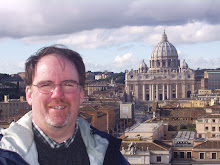
Bob Batastini, the long-time managing editor for GIA Publications in Chicago, was recently interviewed by a new blog (Pray Tell) regarding liturgical music resources and the new Roman Missal. It's worth reading (click here to see the full text).
Bob gave an impressive talk in Madison regarding the state of Catholic Church music several years ago. He always maintained a position in parish ministry throughout his many years at GIA. He is an excellent church musician and remains a welcome voice!
Tuesday, February 9, 2010

Monday, February 1, 2010
"Love is God's Very Essence"
+square.jpg) At yesterday's Angelus, the Holy Father spent some time speaking about the day's Second Reading for Mass (I Corinthians 12:31-13:13), Saint Paul's wonderful description of love. Pope Benedict XVI himself described this as one of the most beautiful passages of the entire Bible.
At yesterday's Angelus, the Holy Father spent some time speaking about the day's Second Reading for Mass (I Corinthians 12:31-13:13), Saint Paul's wonderful description of love. Pope Benedict XVI himself described this as one of the most beautiful passages of the entire Bible.The following comes from the Vatican News Service report of his remarks.
"Charity", the Pope explained, "is the 'greatest' gift, which gives value to all the others. ... In the end, when we find ourselves face to face with God, all other gifts will fail and all that will be left to last for eternity is love, because God is love and we will be like unto Him, in perfect communion with Him.
"For now", he added, "as long as we are in this world, charity is the distinctive mark of Christians. It is the synthesis of all their lives, of what they believe and what they do..."
The Holy Father went on: "Love is God's very essence, it is the meaning of creation and history, it is the light that gives goodness and beauty to the existence of each man and woman. At the same time love is, so to say, the 'style' of God and of believers, it is the behaviour of those who, responding to the love of God, order their lives as a gift of self to God and to neighbour."
Monday, January 25, 2010
Conversion
 Today (January 25) is the Feast of the Conversion of Paul the Apostle. One of the optional readings for the day recalls the dramatic story of Paul's conversion, knocked from his horse by the Lord himself (depicted in the painting to the left by the Renaissance master Caravaggio). Saul's conversion, which took place even as he was going to Damascus to persecute Christians, is yet another example of God's generous mercy and his tireless patience with imperfect men and women.
Conversion is an interesting word. In Church-speak it involves more than just embracing a new life. It also involves turning away from the things that interfere with the new life as well. In ancient times those to be baptized would face the west (the place where the sun set and from where darkness comes) to reject satan; they would then turn to face the east (the place of the rising sun / Son) to profess their faith, turning their backs on their former lives. Today, our baptismal profession still requires us to reject satan and all his empty promises and to profess our belief in the Triune God (although we no longer physically turn).
I often speak with liturgists about conversion. When planning liturgies people often approach from the angle of "I don't like (or understand or appreciate) this aspect of the liturgy...how can it be changed?" Instead, I think that the question should be, "I don't like (or understand or appreciate) this aspect of the liturgy...how can I change?" We don't change things to suit our vision. We allow our hearts to be changed to live in Christ.
Thursday, January 21, 2010
Resources for Lent
 It's not too early to start thinking about resources to help parishioners fully celebrate Lent, Triduum and Easter.
I've listed some excellent Lenten resources below. Some are new, some are proven favorites from the past. Some are for everyone, some might just be for you. Feel free to suggest your own through the comments form.
From Liturgy Training Publications:
- Bible Stories for the Forty Days, by Melissa Musick Nussbaum. A story book for children.
- Forty Days and Forty Nights: A Lenten Ark, by Judy Jarrett and Peter Mazar. This is a Lenten version of an Advent calendar.
- Introduction to Lent and Eastertime, by Gabe Huck. A wonderful booklet at a low price that can be used with small groups.
- Keeping Lent, Triduum and Easter. A classic.
- Keeping the Seasons. Reproducible resources (English and Spanish) for Lent, Triduum and Easter 2010.
- What am I doing for Lent this year? (2nd edition), by Paul Turner. Also available in Spanish and in an edition for teens.
From the Federation of Diocesan Liturgical Commissions (FDLC):
- Bulletin Inserts for Lent, Triduum and Easter, by Thomas A. Dente.
From the Liturgical Press:
- A Crucified Christ in Holy Week, by Raymond Brown.
- Lent with Bishop Morneau.
- Living Liturgy Lent Bulletin Inserts.
- Not by Bread Alone: Daily Reflections for Lent 2010, by Jay Cormier. Also available as an e-book and in a large-print version.
Obviously, this list could go on and on. I hope that this is useful to you and, as I said above, share your own suggestions via the comment page.
The graphic is Jésus et la femme samaritaine ("Jesus and the Samaritan woman") from a series of works based upon the Gospel of Saint John by contemporary artist Corinne Vonaesch.More on Haiti
The United States Conference of Catholic Bishops have added a page to their website featuring news about Haiti. It is estimated that 1/3 of the population will need emergency assistance.
In addition to the extreme misery for the entire population, there has been an impact on this Catholic country's Church. The archbishop, along with many clergy and ministers, are among the casualties and Port-au-Prince's Cathedral and many parish churches were destroyed. According to a press release on the USCCB website:
The impact of the earthquake in Haiti will be felt for years, especially in the life of the Catholic Church. The cathedral, many parishes, Catholic schools and other church buildings have been destroyed. Pastoral programs will also need to be rebuilt so that the Church in Haiti will continue to be a place of sacramental life.
Tuesday, January 19, 2010
That they may be one
This week (January 18-25, 2010) is the annual world-wide commemoration called the Week of Prayer for Christian Unity. In this country it is embraced by some communities and, sadly, ignored by others.
The Pontifical Council for Christian Unity co-publishes prayer and study guides each year. The United States Conference of Catholic Bishops teams up with the Graymore Institute for Ecumenical and Interreligious Dialogue to make these resources available in our country.
The centerpiece of this year's Week of Prayer is the 24th Chapter of Saint Luke's Gospel. According to the resources posted on the Vatican's website:
The Pontifical Council for Christian Unity co-publishes prayer and study guides each year. The United States Conference of Catholic Bishops teams up with the Graymore Institute for Ecumenical and Interreligious Dialogue to make these resources available in our country.
The centerpiece of this year's Week of Prayer is the 24th Chapter of Saint Luke's Gospel. According to the resources posted on the Vatican's website:
During the 2010 Week of Prayer for Christian Unity we will reflect each day on chapter 24 of Luke's gospel stopping at the questions which it asks: Jesus' questions to his disciples; the questions the apostles ask of Christ.
Each of these questions allows us to highlight a particular way of witnessing to the Risen One. Each of them invites us to think about our situation of church division and about how, concretely, we can remedy that. We are already witnesses and we need to become better witnesses. How?
by praising the One who gives us the gift of life and resurrection (Day 1)
by knowing how to share the story of our faith with others (Day 2)
by recognizing that God is at work in our lives (Day 3)
by giving thanks for the faith we have received (Day 4)
by confessing Christ's victory over all suffering (Day 5)
by seeking to always be more faithful to the Word of God (Day 6)
by growing in faith, hope and love (Day 7)
by offering hospitality and knowing how to receive it when it is offered to us (Day 8)
Would our witness not be more faithful to the gospel of Christ in each of these eight aspects if we witnessed together?Source: Resources for the Week of Prayer for Christian Unity
Wednesday, January 13, 2010
Out of the depths

Out of the depths I call to you, LORD;
LORD, hear my cry!May your ears be attentive to my cry for mercy. (Ps. 130:2)Photo by Frederic Dupoux/Getty Images
Merciful and loving God,
you set the earth on its foundations
and covered it with the oceans.
Look with your great compassion on the people of Haiti:
welcome those who died into your heavenly kindgdom,
comfort those who still suffer amidst the rubble,
strengthen those who seek to help,
reunite those who are separated,
and console those who mourn their dead.
Grant that the people of Haiti
may rise from the depths of this great tragedy
trusting in your Divine Mercy and Providence.
We ask this through Christ our Lord.
Amen.
*****
UPDATE (Jan. 13 at 1 p.m.)
Click here for a link to another prayer
composed by Diana Macalintal,
Director of the Office of Worship of the Diocese of San Jose.
Her blog, The Work of the People, is a very thoughtful and well-informed addition to the blogosphere.
*****
UPDATE (Jan. 13 at 1:25 p.m.)
UPDATE (Jan. 13 at 1:25 p.m.)
The Diocese of Madison announces plans for a collection to assist the people of Haiti (click here for Diocesan press release).
Subscribe to:
Posts (Atom)